
Optimizing Urban Traffic Flows Using Advanced Data-Driven Machine Learning Models
Article Sidebar
Main Article Content
Abstract
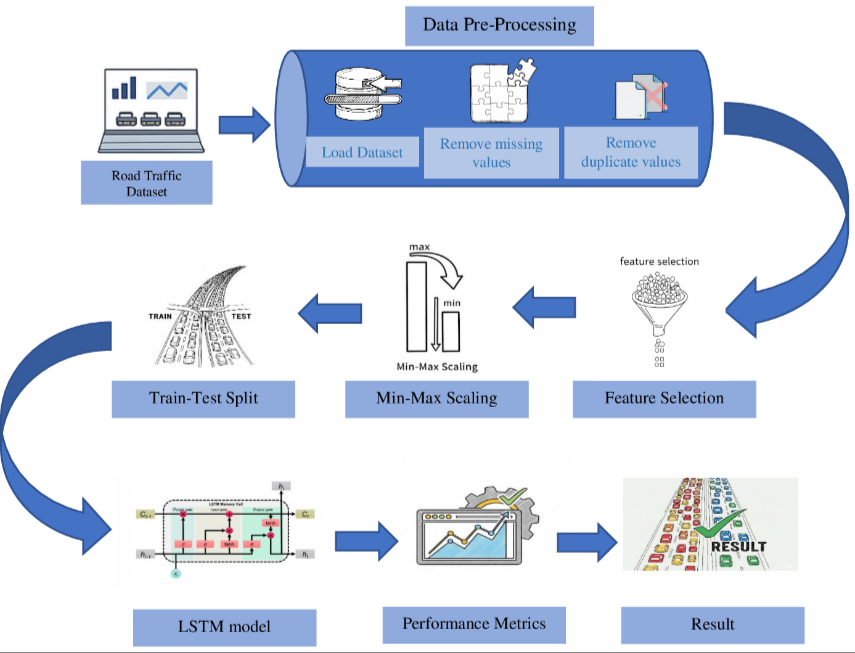
Traffic congestion has lately emerged as a significant worldwide issue due to increasing industrialization and the increased number of vehicles on the road. The control of traffic and congestion is an essential component of urban planning and infrastructure development. Efficient traffic management not only enhances the flow of vehicles but also contributes to reducing fuel consumption, minimizing air pollution, and improving road safety. This study introduces a Long Short-Term Memory (LSTM) model that uses traffic statistics to predict traffic levels. The LSTM design was chosen because of its shown ability to spot complex temporal patterns and long-term correlations in sequential data, which typically go unnoticed by traditional models. Experimental evaluation shows that the proposed LSTM achieved an R² score of 93.45%, with a low Mean Absolute Error (5.504), Root Mean Squared Error (6.857), and Mean Absolute Percentage Error (0.174). Comparative analysis indicates that the LSTM outperformed benchmark models such as standard Neural Networks, Random Forests, and Feedforward Neural Networks on the same dataset. The findings highlight the suitability of deep learning for traffic forecasting tasks and provide a foundation for future research that incorporates real-time conditions and hybrid approaches to further improve prediction accuracy. This work supports the development of smarter, data-driven urban traffic management systems.
Downloads
Article Details

This work is licensed under a Creative Commons Attribution 4.0 International License.
How to Cite