Neutrosophic Social Evolution: Degrees of Evolution, Indeterminacy, and Involution
Article Sidebar
Main Article Content
Abstract
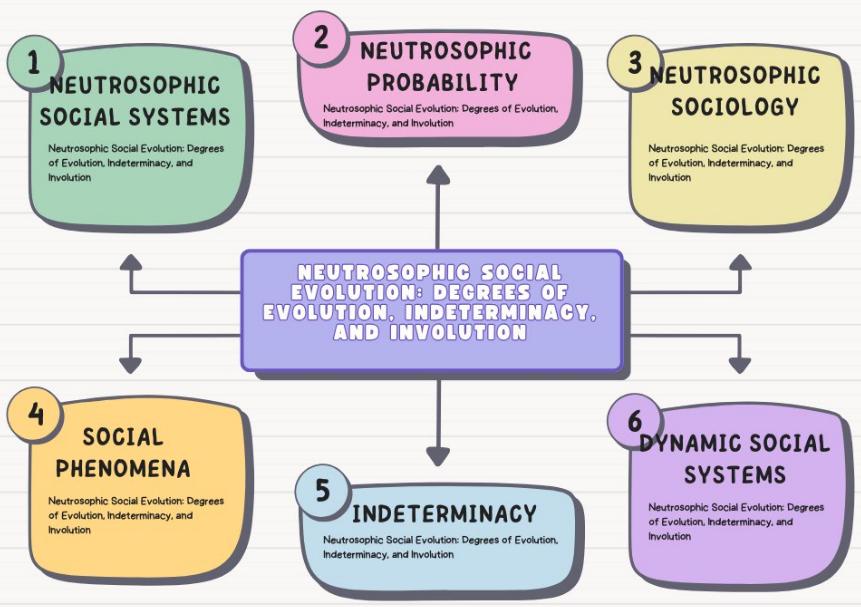
The idea of social evolution has been a core component of sociological thought for centuries, influencing our understanding of societal development, transformation, and the factors that drive social change. Traditional approaches, such as those proposed by Talcott Parsons and Herbert Spencer, emphasize linear processes of development and improvement in society. However, these perspectives often fail to capture the complexity and ambiguity inherent in modern social dynamics. Neutrosophic Social Evolution, as a refinement of these earlier theories, introduces a more nuanced framework that incorporates the roles of evolution, involution, and indeterminacy in the ongoing development of societies. This approach recognizes that social change is not merely a progression toward an ideal state but involves a dynamic interplay of multiple forces, leading to varied outcomes depending on the parameters being considered.
Downloads
Article Details

This work is licensed under a Creative Commons Attribution 4.0 International License.
How to Cite