
A Unified Framework for Calibrated Uncertainty Quantification and Autonomous Threat Response in Self-Healing Cellular Networks
Article Sidebar
Main Article Content
Abstract
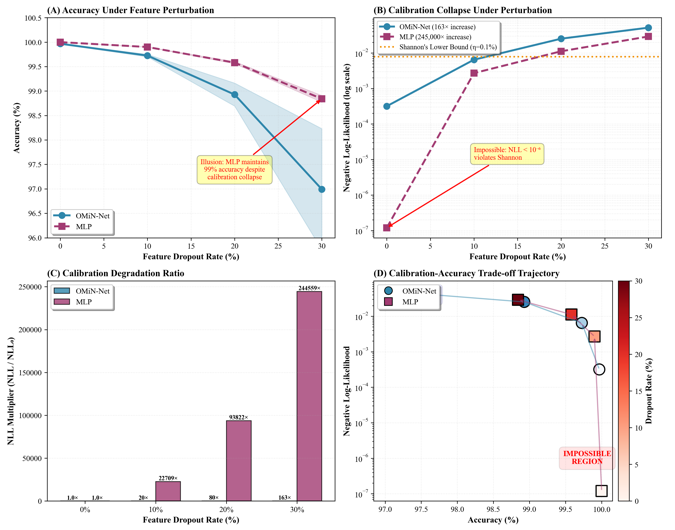
Studying self-organized networks is considered a major factor for cellular networks future development. Self-organized network functional capabilities include self-configuration, self-optimization and self-healing. Existing literature has focused on the first two functionalities compared to self-healing. Small mobile cells higher density and potential failure of their networks due to using massive antennas, demanding a clear self-healing architecture and actions. Our OMiN-Net is a novel architecture that integrate Product-of-Unions gating, residual flow dynamics, and classification based on learned RBF. We evaluate OMiN-Net on 5G-NIDD dataset, and the model archives 99.49% accuracy with 0.00247 Expected Calibration Error. In feature dropout experiments, OMiN-Net achieves 98.93% accuracy, and NLL increases from 0.00032 at 0% dropout to 0.0253 under 20% feature dropout. The Cross-dataset transfer test on CICIDS-2017 shows that MLP accuracy decreased 66.8% compared to OMiN-Net with 33.7% degradation and 0.023 welch –p -value. MLP training variance is σ²=0.0 and OMiN-Net is σ^2=2.62×〖10〗^(-6). This study presents a novel architecture that employs mixture-of-experts, normalizing flows, and distance-based prediction confidence, robustness evaluation based on feature dropout and cross-data transferee tests, Profs for architectures memorization patterns
Downloads
Article Details

This work is licensed under a Creative Commons Attribution 4.0 International License.
How to Cite