HyperFuzzy Multisets and (m,n)-SuperHyperFuzzy Multisets: Case Studies and Applications in Medical Science and Diagnosis
Article Sidebar
Main Article Content
Abstract
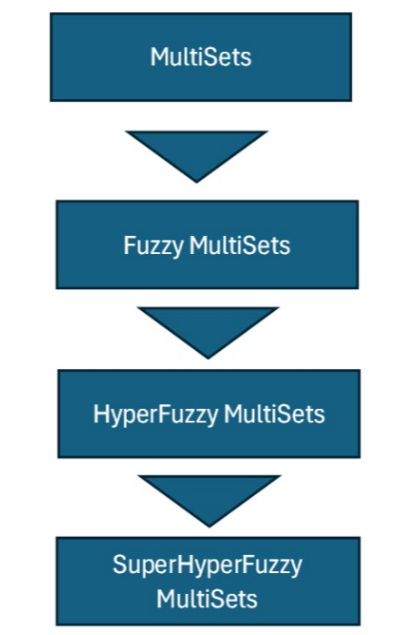
Uncertainty in complex systems has motivated many well-known generalizations of classical set theory, including fuzzy sets, intuitionistic fuzzy sets, and other degree-based formalisms. In particular, a fuzzy set on a universe Y associates with each element y ∈ Y a membership value in [0, 1], so that belonging may vary continuously rather than being purely binary. Multisets extend ordinary sets by permitting repeated occurrences of the same element, and a fuzzy multiset refines this idea by allowing each element to be equipped with multiple membership values in (0, 1]. Hyperfuzzy sets broaden the model further by assigning to each y ∈ Y a nonempty subset of [0, 1], thereby capturing uncertainty together with intrinsic variability of membership. Continuing this line of development, (m, n)-superhyperfuzzy sets assign to each nonempty member arising from the m-fold and n-fold iterated powerset constructions a nonempty family of subsets of [0, 1], which supports nested and hierarchical representations of imprecision. A substantial body of work has also explored medical applications of fuzzy methods and their extensions, notably in medical diagnosis, where such tools have been widely employed. Despite the broad use of fuzzy and hyperfuzzy notions in artificial intelligence, decision-making, algebra, topology, and control theory, more expressive structures–including hyperfuzzy multisets and (m, n)-superhyperfuzzy multisets—have received comparatively limited attention. In this paper we introduce these new objects, give precise formal definitions, and study their basic mathematical properties. We expect that subsequent research will design computational procedures and pursue application-oriented investigations that more fully exploit these advanced multiset frameworks. In addition, we provide several illustrative medical and biomedical examples of HyperFuzzy Multisets and SuperHyperFuzzy Multisets.
Downloads
Article Details

This work is licensed under a Creative Commons Attribution 4.0 International License.
How to Cite