
Novel Types of Upside-Down Logic in Plithogenic Fuzzy Sets
Article Sidebar
Main Article Content
Abstract
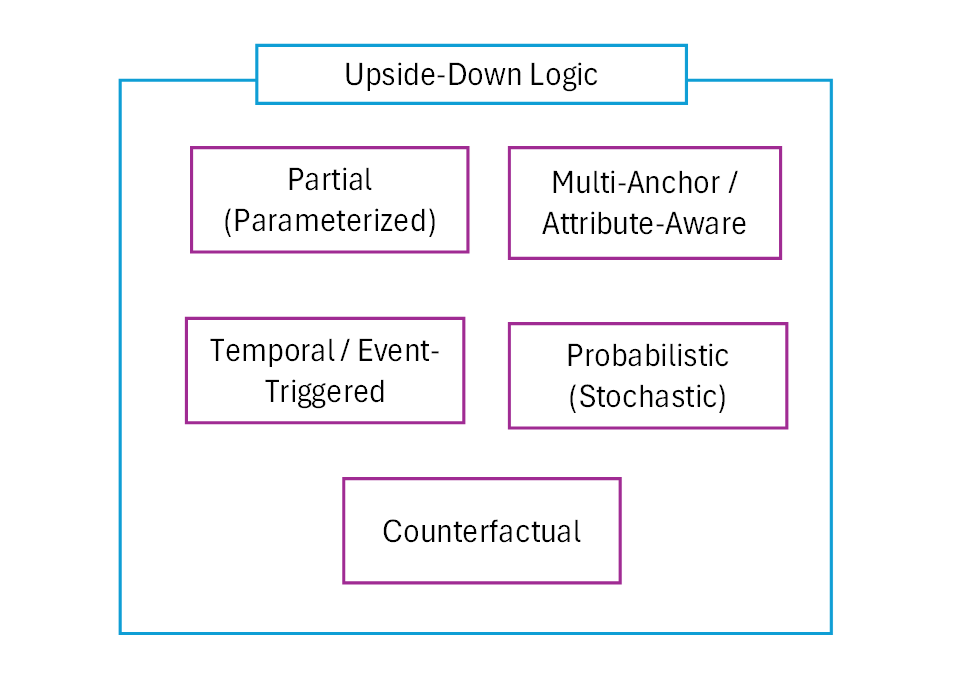
In the real world, numerous reversal phenomena occur, such as cases where a statement once considered false is later acknowledged as true. Upside-Down Logic is a framework designed to formalize such reversals within a logical system. It inverts the truth and falsity of propositions through contextual transformations, thereby capturing ambiguity and context-dependent reversals in reasoning. A Plithogenic Set models elements using attribute-based membership and contradiction functions, extending the classical frameworks of fuzzy, intuitionistic, and neutrosophic sets. The essential distinction between Plithogenic Sets and traditional Fuzzy Sets lies in their ability to incorporate contradiction parameters, which naturally emerge when uncertainty transitions into certainty. Since research on Upside-Down Logic is still in its early stages, only a few extended logical systems have been defined so far. Therefore, this paper introduces five new concepts: Partial (Parameterized) Upside-Down Logic, Multi-Anchor / Attribute-Aware Upside-Down Logic, Temporal / Event-Triggered Upside-Down Logic, Probabilistic (Stochastic) Upside-Down Logic, and Counterfactual Upside-Down Logic.
Downloads
Article Details

This work is licensed under a Creative Commons Attribution 4.0 International License.
How to Cite