
Hybrid Machine Learning Models for Enhanced Student Performance Prediction
Article Sidebar
Main Article Content
Abstract
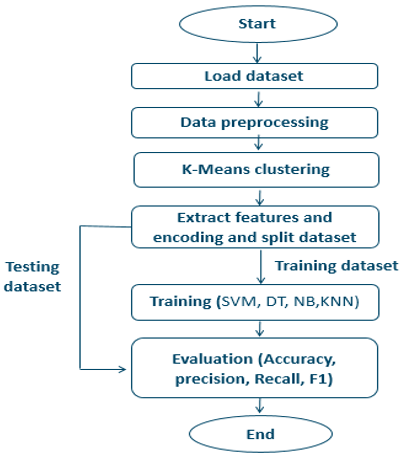
Predicting student academic performance is a critical task for educational institutions seeking to enhance learning outcomes and identify students at risk of underachievement. With the integration of artificial intelligence in education, machine learning (ML) techniques provide effective tools for modeling educational data and supporting data-driven decision-making. This study proposes a hybrid approach combining unsupervised and supervised learning to identify the most influential features affecting student performance and accurately classify academic outcomes. Initially, K-Means clustering was applied to the preprocessed dataset, and clustering quality was assessed using the Davies–Bouldin Index, yielding a score of 3.25. Subsequently, four classification algorithms—Support Vector Machine (SVM), Decision Tree, Naïve Bayes, and K-Nearest Neighbors (KNN)—were implemented and evaluated using standard performance metrics. Following hyperparameter optimization via Grid Search CV , SVM achieved the highest predictive performance, with an accuracy of 87.08%, precision of 87.21%, recall of 87.08%, and F1-score of 86.36%, whereas KNN exhibited the lowest performance, with 73.68% accuracy and 67.52% F1-score. These findings highlight the superiority of SVM for academic performance prediction and the relative limitations of KNN. Overall, the study demonstrates the effectiveness of optimized ML models in educational data mining and provides valuable insights for the development of intelligent student support systems. Code: https://github.com/Salmao6u/CNN.git
Downloads
Article Details

This work is licensed under a Creative Commons Attribution 4.0 International License.
How to Cite