
Investigating the Stability of a Perturbed Figure-8 Four-Body System Using Symplectic Integration
Article Sidebar
Main Article Content
Abstract
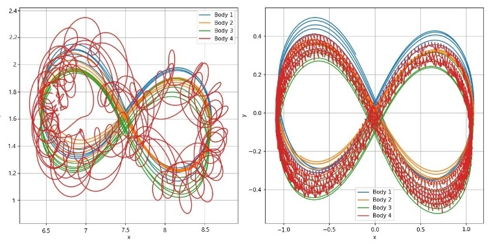
The figure-8 choreography of the equal-mass three-body problem is a rare example of a symmetric periodic solution in Newtonian gravity. In this study, we investigate the robustness of this orbit under a controlled perturbation: introducing a fourth body with variable mass and initial velocity while preserving the authorized figure-8 initial conditions for the original three bodies. We integrate the planar four-body equations of motion using a second-order symplectic leapfrog (velocity-Verlet) method to reduce long-term numerical drift in conserved quantities. Stability is quantified through a stability time defined by (i) a minimum pairwise-distance threshold to detect close encounters and (ii) a boundedness/escape threshold for the fourth body. In addition, we monitor total energy and total angular momentum as diagnostics of numerical integrity and physical consistency. A parameter scan over the fourth-body mass and speed produces a stability map that highlights rapid destabilization in most of the explored regions, with narrow islands of longer stability. Representative trajectory plots show that low-speed injections tend to produce close encounters, moderate speeds can yield bounded motion for longer times, and high speeds often result in escape (unbound trajectories). The results demonstrate how small perturbations can preserve the choreography over long integration windows, while stronger perturbations trigger chaotic scattering and a sharp reduction in stability time.
Downloads
Article Details

This work is licensed under a Creative Commons Attribution 4.0 International License.
How to Cite