
An AI-Enabled Integrated Framework for Diabetes Risk Screening, Self-Management, and Care Navigation
Article Sidebar
Main Article Content
Abstract
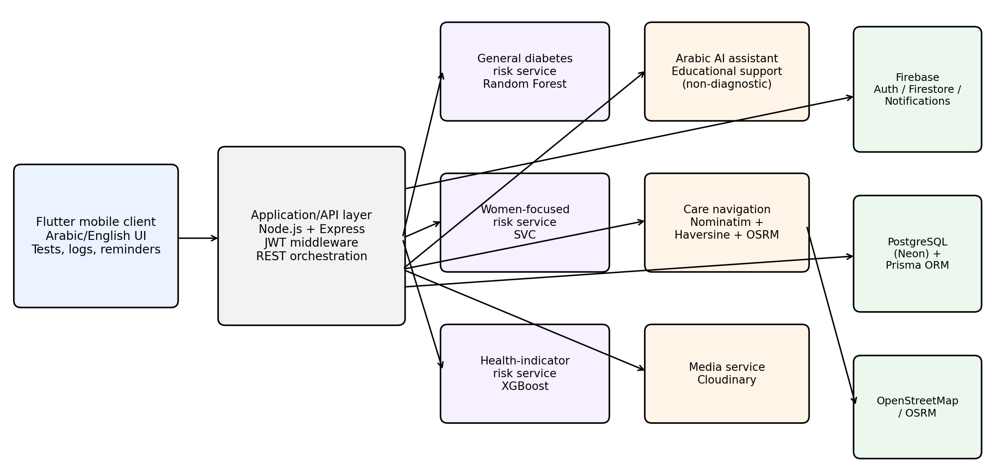
Diabetes management applications commonly emphasize logging and reminders, whereas machine-learning studies often evaluate prediction models outside the workflow in which users act on their outputs. This paper presents Diabetes, a mobile platform that integrates tabular risk screening, self-management support, Arabic-language educational assistance, and location-aware care navigation within one deployable architecture. The system combines a Flutter client with Node.js/Express services, hybrid Firebase/PostgreSQL persistence, three task-specific classifiers, and OpenStreetMap/OSRM-based doctor routing. The predictive layer is evaluated on three public tabular benchmarks. On the archived internal test splits, the Random Forest general-risk model achieved 94.10% accuracy, 90.11% sensitivity, 98.10% specificity, and ROC-AUC 0.9916; the SVC women-focused risk model achieved 90.29% accuracy and ROC-AUC 0.95; and the XGBoost health-indicator model achieved 94.99% accuracy, 95.00% sensitivity, 94.98% specificity, and ROC-AUC 0.9900. The publication version deliberately distinguishes risk screening from clinical diagnosis. In particular, the 1,000-record women-focused benchmark contains pregnancy-count and metabolic variables but does not constitute a gestational-diabetes cohort; it is therefore not presented as evidence of gestational-diabetes diagnostic validity. The study’s contribution is an end-to-end digital-health architecture that couples model outputs to monitoring, educational support, and clinician navigation while making evaluation boundaries explicit. Because the reported results arise from public benchmark data and internal development splits, they should be interpreted as proof-of-concept performance rather than prospective clinical validation.
Downloads
Article Details

This work is licensed under a Creative Commons Attribution 4.0 International License.
How to Cite