
Peritumoral Expansion Radiomics with Bayesian Optimization for Enhanced Lung Cancer Classification
Article Sidebar
Main Article Content
Abstract
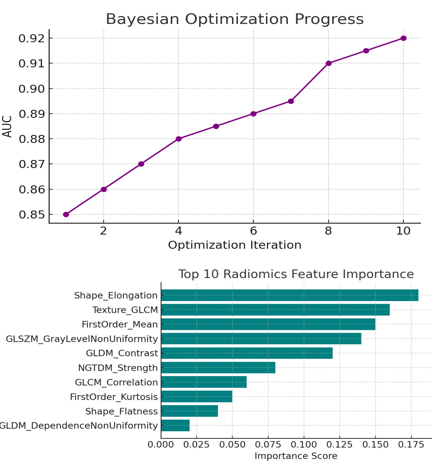
Lung cancer is the leading cause of cancer death worldwide, primarily due to late diagnosis. This research enhances existing research in radiomics-based lung cancer classification by integrating Bayesian Optimization into the model training process. Segmentation of nodules was performed using a K-Nearest Neighbors approach and radiomics features were extracted from nodules and Peritumoral areas based on the Duke Lung Cancer Screening Dataset. These features included shape, intensity, and texture features derived from the PyRadiomics library. Logistic Regression served as the model classification due to its simplicity and interpretability in the clinical sense. Bayesian Optimization optimized the hyperparameters of the model to maximize its generalization and predictive ability. Results show that this provided an appreciable increase in performance with the AUC rising from 0.89 to 0.92. These findings demonstrate the potential of combining traditional machine learning and state-of-the-art optimization techniques to develop precise and interpretable diagnostic tools that could assist radiologists in detecting and describing lung cancer nodules at an early stage.
Downloads
Article Details

This work is licensed under a Creative Commons Attribution 4.0 International License.
How to Cite