
Enhancing the Accuracy of Diabetes Prediction Using Machine Learning Models: A Comparative Analysis
Article Sidebar
Main Article Content
Abstract
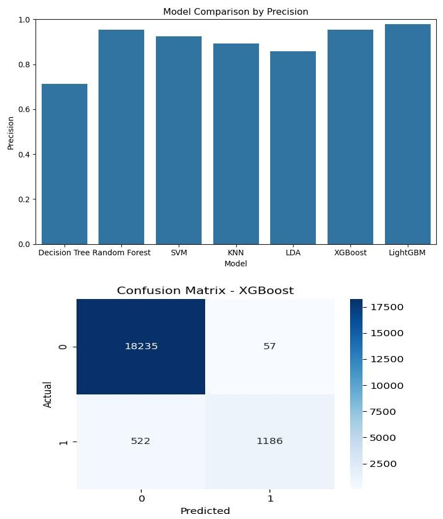
Accurate and timely detection of diabetes is vital for effective medical intervention and lifestyle modification. Traditional diagnostic methods, however, frequently lack adaptability and scalability across various populations. Using a sizable real-world dataset of 100,000 patient records, this study compares seven supervised machine learning algorithms for diabetes prediction: Decision Tree, Random Forest, Support Vector Machine (SVM), K-Nearest Neighbours (KNN), Linear Discriminant Analysis (LDA), XGBoost, and LightGBM. To improve data quality, extensive preprocessing procedures were used, such as class balancing using SMOTE, categorical encoding, feature scaling, and missing value imputation. According to experimental data, the Random Forest model outperformed other models with the highest accuracy (97.07%) and F1-score (0.80). The results emphasize the value of model selection in creating dependable medical decision-support systems and the efficacy of ensemble learning and preprocessing in enhancing predictive performance. The findings underscore the effectiveness of ensemble learning and preprocessing in improving predictive performance and highlight the importance of model selection in designing reliable medical decision-support systems.
Downloads
Article Details

This work is licensed under a Creative Commons Attribution 4.0 International License.
How to Cite