
An Integrated Mobile Health System for Medication Management and Molecular Drug-Drug Interaction Screening Using Transformer-Based Learning
Article Sidebar
Main Article Content
Abstract
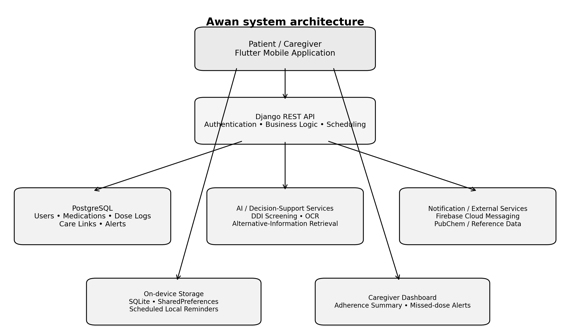
Medication-management systems often separate reminder functions from interaction-risk screening, caregiver support, and evidence-bounded medication information. This study presents Awan, a mobile-health research prototype that integrates medication scheduling, dose logging, optical medication capture, caregiver monitoring, pharmacy lookup, nutrition support, and drug-drug interaction (DDI) screening within a Flutter-Django client-server architecture. The DDI module compares name-based classical baselines, Morgan-fingerprint XGBoost models, and a ChemBERTa transformer operating on SMILES representations. On the recorded stratified pair-level test partition (n = 65,621), ChemBERTa produced 19,238 true negatives, 2,029 false positives, 3,336 false negatives, and 41,018 true positives, yielding accuracy 0.9182, positive-class precision 0.9529, recall 0.9248, F1-score 0.9386, specificity 0.9046, balanced accuracy 0.9147, and ROC-AUC 0.9635. Because class-0 examples were sampled from pairs not annotated as positive interactions, they are treated as operational pseudo-negatives rather than clinically proven non-interactions; because splitting occurred at the drug-pair level, the experiment establishes held-out pair performance rather than unseen-drug generalization. The scientific contribution is a safety-aware system integration that couples adherence and caregiver workflows with an experimentally evaluated molecular DDI service and an evidence-bounded herbal information layer while explicitly separating informational support from prescribing or therapeutic substitution. The prototype demonstrates the feasibility of this architecture and defines the validation boundaries required for responsible clinical translation.
Downloads
Article Details

This work is licensed under a Creative Commons Attribution 4.0 International License.
How to Cite