
Using GIS to Evaluate of Irrigation Water Quality within the Boundaries of Tal-Afar district - Iraq
Article Sidebar
Main Article Content
Abstract
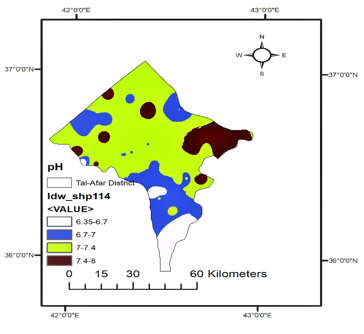
This study was conducted for the purpose of evaluating the irrigation water within the boundaries of Tal Afar district according to the most common water classification system, which is the Richard classification of 1954, based on the relationship between the sodium adsorption ratio (SAR) and the electrical conductivity (EC). then assessing its suitability for irrigation purposes, and then indicating the origin of that water, from This study found that all irrigation water samples fall into the categories C3-S1, C4-S1, indicating that the water is very high salinity to low sodium saline based on chemical indicators of well water and spatial trends using geographic information systems. The results showed that there were variations in water quality in different locations, as the pH values ranged between (6.32-7.8), the electrical conductivity values were (0-10000) µm/cm, the chlorides were (0.27-17.21) FMEq/L, and the sulphates were (0.3-24). ) mmeq/l, potassium (0.52-0.02) mmeq/l, sodium (0.09-17.9) mmeq/l, calcium (0.12-22) mmeq/l, magnesium (0.64-21.6) mmeq/l, and the percentage of sodium (87) (-21) %, and the sodium adsorption rate was (0.09-11.6) mmeq/l. As for the origin of groundwater, according to the Jones index, it is water of atmospheric origin for 66% of the well data, and 34% of it is of marine origin.
Downloads
Article Details

This work is licensed under a Creative Commons Attribution 4.0 International License.
How to Cite