
Current and Future Challenges for Water Demand Versus Supply in Tel–Afar District
Article Sidebar
Main Article Content
Abstract
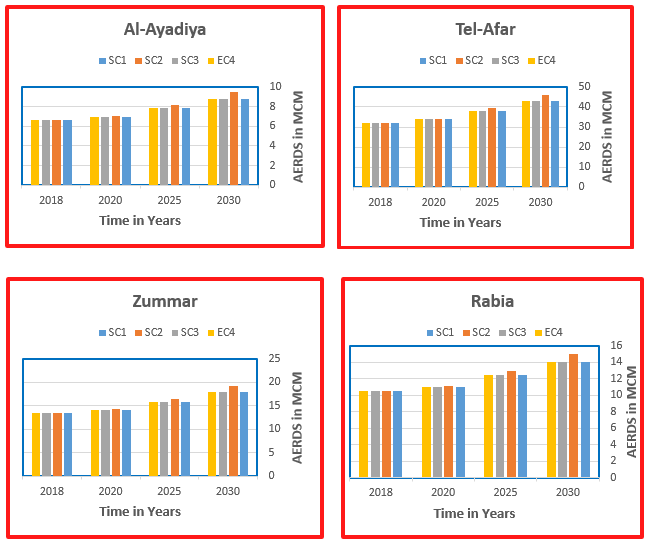
The current study was conducted using modern technologies in the engineering fields, represented by the GIS program, which specializes in spatial analysis of data, creating digital models, and generating additional data for them, in addition to using the Scenarios model method, which is a tool for warning of what the future will lead to according to the proposed and expected scenarios. The results of the study showed that the main source of water supply in the study area for the municipal sector is the public water network, which is supplied with water from the Tigris River, at a rate of (93%) of the total supply of municipal sector water, and (7%) of groundwater supply. The results showed that the demand for water for the municipal sector in the center of Tal-Afar district accounts for more than (83.5%) of the total demand, followed by the agricultural and livestock sector at a rate of (17.5%), while in the Al-Ayadhiya district, the agricultural and livestock demand recorded a rate of (69.80%) and the municipal demand recorded (30.2%) of the total demand, and in the Zummar district, the agricultural and livestock sector recorded a rate of (66.1%) of the total demand, and (33.9%) for the municipal sector, and in the Rabia district, the largest share was for the agricultural and livestock sector, which recorded (96.5%) of the total demand and (3.5%) for the municipal sector. The results showed that the water gap for the municipal sector is non-existent in the center of Tal-Afar district and records A surplus of (12.5 MCM) then appears in each of Zummar, Al-Ayadhiyah and Rabia and records a deficit in the supply of (0.67, 3.35, 3.59 MCM) respectively and this shortage is addressed by increasing the time period for withdrawing water, or pumping through unlicensed wells. The results of the possible scenarios showed that the best scenario for the municipal sector are scenarios (4,3) which reduce the water gap by increasing the supply and maintaining the demand for water by (33%) while the worst scenario was scenario (2) which leads to an increase in the demand for water by 42.5%.
Downloads
Article Details

This work is licensed under a Creative Commons Attribution 4.0 International License.
How to Cite