
A Comprehensive Review of Explainable Artificial Intelligence (XAI): Methods, Challenges, and Future Directions
Article Sidebar
Main Article Content
Abstract
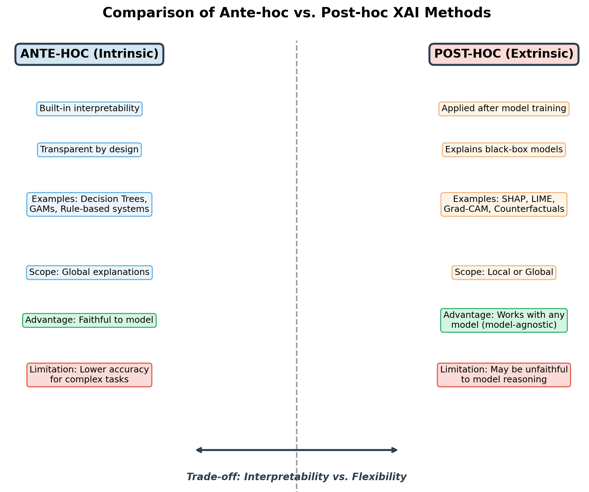
The growing use of Deep Learning and other complex machine learning models in safety-critical areas raises fundamental questions of model interpretability and explainability in human understandable terms. Explainable Artificial Intelligence (XAI) has recently emerged as a field of research that aims at making complex machine learning models more transparent, explainable and accountable, and this review provides a comprehensive, structured and formal analysis of the current state of XAI along four dimensions: (1) explanation types (model-agnostic vs. model-specific, global vs. local, intrinsic vs. posthoc, etc.), (2) explanation methods (salience maps, feature importance, model interpretability, surrogate models and model explainability), (3) evaluation metrics (faithfulness, interpretability, stability) and (4) applications (healthcare, computer vision, natural language processing, recommender systems, time series analysis, etc.), while also discussing open research directions towards advancing the state-of-the-art in XAI and providing guidance for readers to navigate the current body of knowledge in this area based on their interests and expertise. This review is based on a survey of more than 40 papers between 2020 and 2026 and is aimed at providing a concise and informative review to researchers and practitioners in the field of XAI.
Downloads
Article Details

This work is licensed under a Creative Commons Attribution 4.0 International License.
How to Cite