
Cross-Domain Computer Vision Model for Adverse Weather Image Recognition
Article Sidebar
Main Article Content
Abstract
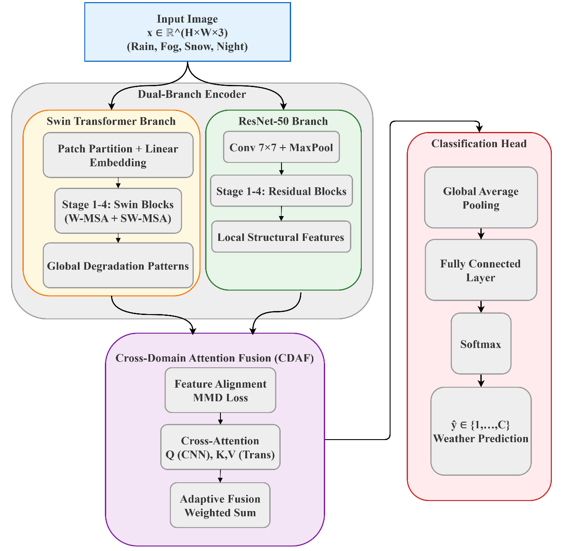
Real-world computer vision systems are affected by various types of weather conditions, such as fog, rain, snow, haze, etc.; however, the models trained on clean images can't generalize well to real-world images due to the significant change of visual appearance under different weather conditions. Most of the existing methods either treat weather removal and visual recognition as two separate tasks or focus on a single type of degradation at a time, which is less applicable to practical scenarios where a variety of adverse weather may exist; therefore, in this paper, we propose a unified CDW-Net (Cross-Domain Weather-Aware Vision Network) for image recognition under various challenging weather conditions. The proposed CDW-Net employs a hybrid architecture consisting of a degradation-aware transformer encoder and a convolutional feature refinement decoder, which enables both understanding and classification of weather-degraded images in one framework. Specifically, the network contains two main branches, including a global self-attention branch built on a modified Swin Transformer to capture the long-range degradation patterns caused by weather and a local convolutional branch to capture the fine-grained structural details that remain visible even if parts of the scene are occluded or blurred. The two streams of features are then combined by a Cross-Domain Attention Fusion (CDAF) module, which also applies the Maximum Mean Discrepancy (MMD) regularization to better align the feature distributions of clean (source) and degraded (target) domains for mitigating the domain shift. Consequently, we evaluate the proposed CDW-Net on three benchmark datasets, i.e., Multi-class Weather Dataset (MWD), Weather Phenomenon Database (WEAPD), and Detection in Adverse Weather Nature (DAWN) dataset, where CDW-Net achieves top-1 accuracies of 97.84%, 91.23%, and 89.67%, respectively, outperforming all the state-of-the-art baselines. Ablation studies indicate that each of the architectural components contributes meaningfully to the final performance; moreover, our proposed framework is also scalable and practical for deployment in real-world all-weather visual recognition applications, such as autonomous driving, surveillance, and intelligent transportation systems.
Downloads
Article Details

This work is licensed under a Creative Commons Attribution 4.0 International License.
How to Cite