
ExplainNet-MLC: Explainable Deep Learning with Graph-Based Label Correlation for Chest X-Ray Disease Classification
Article Sidebar
Main Article Content
Abstract
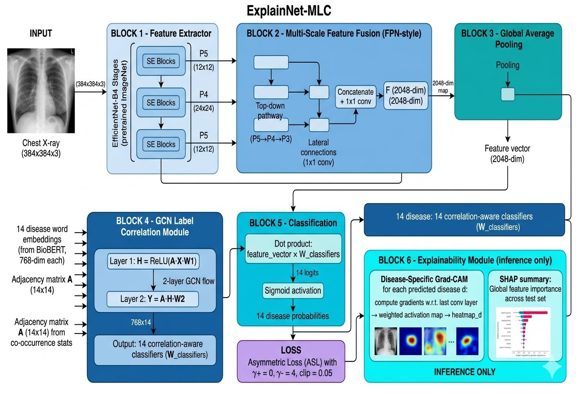
Automated multi-label classification of chest X-ray images is essential in clinical diagnosis, but current methods have three major weaknesses: they treat diseases as dissimilar labels instead of paying attention to clinically relevant co-occurrence information, they make opaque predictions, which do not provide a spatial explanation of individual diseases, and they do not address the extreme class imbalance of chest radiograph data. This paper proposes ExplainNet-MLC, a new architecture that combines EfficientNet-B4 with Squeeze-and-Excitation attention, a Graph Convolutional Network (GCN) label-correlation module that identifies dependencies among diseases, and a disease-specific Grad-CAM explainability module that produces a heatmap for each predicted pathology. Asymmetric Loss is adopted to mitigate the severe positive-negative imbalance in multi-label classification. Extensive experiments on ChestX-ray14 (112,120 photos, 14 diseases) and CheXpert (224,316 photos) show that ExplainNet-MLC has a mean AUC of 0.848, which is statistically significant compared to CheXNet (0.841), CheXGCN (0.838), SwinCheX (0.810), and CRAL (0.816) (p < 0.01, DeLong test). The suggested GCN module increases AUC by +1.2% with the help of inter-disease correlation modeling, whereas Asymmetric Loss introduces an additional improvement of +0.8% over the traditional binary cross-entropy. Qualitative results reaffirm that disease-specific Grad-CAM heatmaps correctly localize pathological regions, which can give clinically meaningful explanations that mediate the high-performance classification and clinical interpretability gap.
Downloads
Article Details

This work is licensed under a Creative Commons Attribution 4.0 International License.
How to Cite